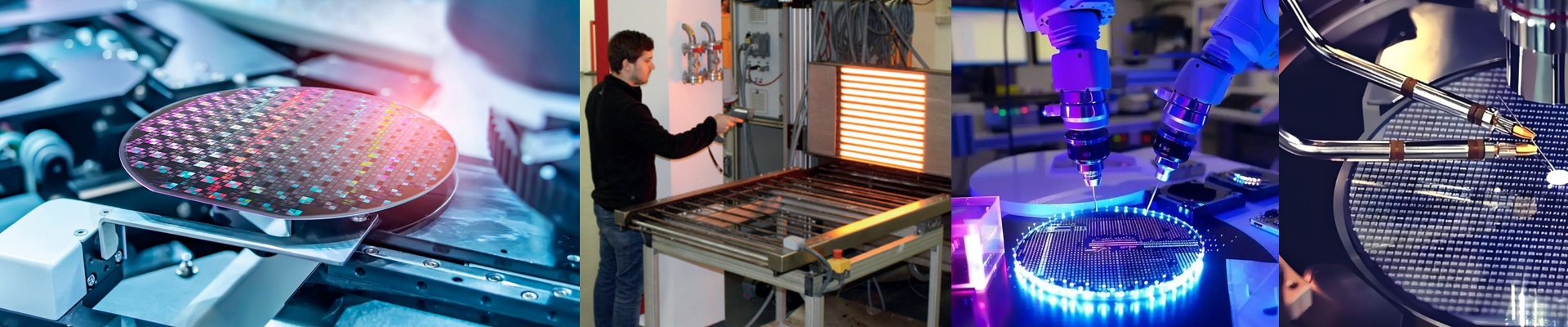
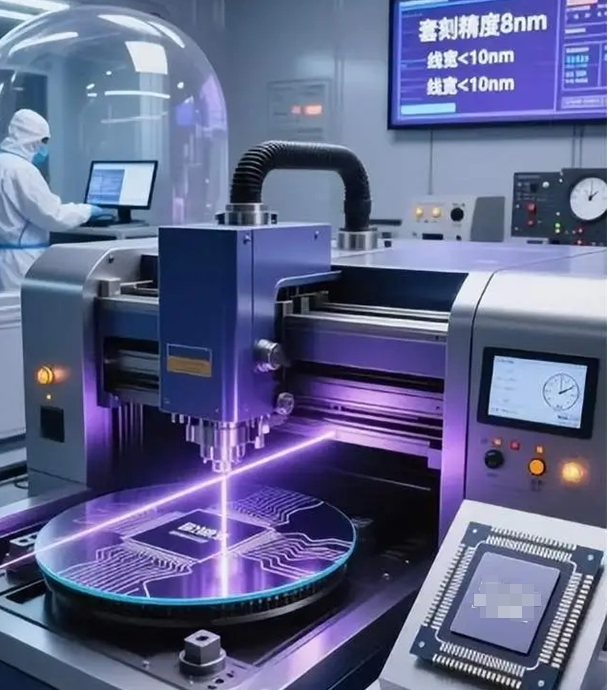
On the line, the 300 mm wafer sits waiting for the bake. Let a soft bake drift by 0.3°C and you’ll see CD shift, overlay skew, and the whole batch headed for rework. The oven setpoint might look stable, but the sensor on the carrier tells a different story—hot spots, cold edges, a thin film that cures all wrong. You run a Class 1–100 cleanroom. You live and breathe particle counts per cubic foot, and you chase every excursion back to its root. Conventional lamps can deliver heat, sure, but they also bring ozone, outgassing, and particulates into the process chamber. They drift. They age unevenly. And when lamp output shifts, your process window shifts right along with it. We built ozone-free infrared lamps to take those variables off the table. The point is thermal control where it counts—at the wafer, not just at the heater.
What matters, technically
Start with near-infrared (NIR) emission in a controlled spectral band, delivered by ozone-free sources. No UV tail. No ozone generation. The quartz envelope and internal geometry are chosen to suppress outgassing and take repeated thermal cycling without flaking. The spec that defines the lamp is temperature uniformity and repeatability at the wafer plane: ±0.1°C across the illuminated area. That isn’t a marketing line; it’s the boundary of process capability. Hit it and your soft bake removes solvent predictably instead of leaving a residual that prints. Your hard bake sets the photoresist profile consistently, lot after lot. We hit that number by aligning three things:
- **Spectral control:**The emission band is tuned to the absorption profile of the photoresist and underlying films, so energy lands where it’s needed—fast, with low thermal inertia.
- **Spatial control:**The lamp array is laid out to map the hot zones of the carrier and compensate for edge losses, giving uniform irradiance.
- **Temporal control:**Closed-loop control at the wafer sensor—not at the lamp housing—keeps temperature inside tolerance through stage motion, lamp warm-up, and line voltage variations. The payoff is repeatability you can put in the log. Temperature ramp profiles repeat within the same tolerance, and soak stability holds without oscillation. That’s what tightens CD and overlay distributions. Cleanroom compatibility is engineered into the materials and mechanics. The lamp body uses low-outgassing compounds and cleanroom-rated finishes. The design avoids crevices and porous surfaces. The air path is contained and the cooling isolated, so the lamp never becomes a particle source. In Class 1–100 environments, that translates to stable particle counts and fewer excursions tied to the heating step. Reliability is measured in hours, not hype. We have units running 5,000+ hours with less than 5% output drop, controlled lumen maintenance, and predictable end-of-life behavior. The lamp head is built for 24/7 duty cycles, and the driver supports fast warm-up with stable output after start.
Why it works in real lithography tracks
In lithography tracks, the bake steps set the film before exposure and after. Soft bake removes solvent to a tight residual. Hard bake hardens the image and gets it ready for etch. Both are thermal budgets that have to be repeatable. Our ozone-free infrared lamps deliver that repeatability exactly where it matters—at the wafer surface. The lamp comes on, the wafer hits setpoint, and the temperature holds. No overshoot. No undershoot. No hot spots at the pins. The temperature profile follows the recipe, and the log shows it. That precision shows up in measurable ways:
- Tighter critical dimension distribution across the wafer, because the photoresist sees the same thermal history at every position.
- Improved overlay accuracy, because the carrier and wafer thermal expansion is consistent from lot to lot.
- Fewer reworks and re-bakes, because the process stays inside the window without drift. Zero particle generation isn’t an abstract promise. It means the lamp isn’t adding to the particle count in the process chamber. Excursions traced to the bake module drop. Filters last longer. Downtime for cleanouts goes down. Energy use drops because the lamp heats the film directly, not the chamber walls. Thermal mass is low, so ramp energy is low, and soak power settles to a low steady state. The driver is efficient, and the lamp doesn’t waste energy in infrared bands that don’t contribute to the bake. The lamp integrates with existing tracks and bake modules. We provide interface dimensions, mounting points, and electrical specs that match typical OEM footprints. The control interface is clean and straightforward—setpoint, ramp, soak, and data log—exactly the way process engineers run recipes.
What you need to know
Ozone-free infrared lamps are forgiving, but they aren’t universal. They perform best when matched to the absorption characteristics of the film stack. If your stack has low absorption in the NIR band, you’ll need to tune the spectral output or adjust the thermal profile. We provide application notes for common photoresists and underlayers to map lamp settings to the process. Installation is simple, but alignment matters. The lamp array has to be positioned to the wafer plane at the specified gap, and the sensor has to sit at the reference point the control loop uses. Misalignment shows up fast as edge nonuniformity. We include fixture kits and alignment targets to set it once and lock it in. Cooling is part of the system, not an afterthought. The lamp head needs clean, dry coolant at the specified flow and temperature. If coolant temperature drifts, lamp output drifts. Tie the cooling to a stable plant water loop or a recirculating chiller with temperature control. The lamp is cleanroom compatible, but the surrounding system has to be, too. Use cleanroom-rated hoses, fittings, and cable management. Keep the lamp head accessible for inspection, and put a preventive maintenance schedule in place that includes window cleaning and sensor calibration checks. Finally, the lamp is designed for long life, but like any consumable, it has a finite duty cycle. Monitor output and temperature stability, and replace on schedule. Planned replacement keeps the process stable and prevents unplanned downtime. On the line, the bake step isn’t background noise. It’s a control point that defines yield. Our ozone-free infrared lamps give you that control back—±0.1°C uniformity, zero particle risk, and repeatability you can prove in the data log. If you’re running photoresist bakes in a Class 1–100 fab and you need the thermal profile to hold inside the process window, this is the right tool for the job.